
<!– wp:html –> <div class="uscb-wrap"> <section class="uscb-intro"> <span class="uscb-label">industry overview</span> <h2>Ammonia Refrigeration Systems Knowledge Hub</h2> <p>Ammonia refrigeration systems are transforming industrial cold storage. They’re efficient, cost-effective, and align with modern environmental standards. This guide breaks down how ammonia systems work, their benefits, and how they fit into multi-temperature modular storage facilities.</p> </section>
<article class="uscb-article" id="article"> <div class="uscb-summary"> <p><strong>At a glance:</strong> Ammonia refrigeration systems are redefining cold storage efficiency and safety.</p> <ul> <li><strong>Ammonia Cascade Systems:</strong> Reduce ammonia use and improve energy efficiency.</li> <li><strong>Modular Ammonia Chiller Units:</strong> Simplify installation and cut refrigerant use.</li> <li><strong>Ammonia DX Systems:</strong> Offer simpler designs with energy savings.</li> <li><strong>Thermal Energy Storage (TES):</strong> Cuts peak energy use and improves temperature stability.</li> </ul> </div>
<div class="uscb-step-title"> <span class="uscb-step">1</span> <h2>Ammonia Cascade Systems</h2> </div> <p>These systems confine ammonia to the machine room, using CO₂ to cool the facility. This cuts ammonia use to just 6–8 lbs per ton, compared to 20–23 lbs in traditional setups. For example, a 250,000-sq-ft facility reduced its ammonia load from 12,700 lbs to 4,400 lbs. Cascade systems also improve energy efficiency by 3% to 16%, making them ideal for facilities with multiple temperature zones.</p> <div class="uscb-quote"> "In a cascade refrigeration application, no ammonia enters the building where product and workers are located. The entire ammonia charge is located and isolated within the equipment room." <cite> – Michael McGinnis, President, Innovative Refrigeration</cite> </div>
<div class="uscb-step-title"> <span class="uscb-step">2</span> <h2>Modular Ammonia Chiller Units</h2> </div> <p>Placing refrigeration equipment closer to the zones they serve reduces refrigerant use and boosts efficiency. These units are gaining popularity for their ability to simplify cold storage management while maintaining precise temperature control.</p>
<div class="uscb-step-title"> <span class="uscb-step">3</span> <h2>Ammonia DX Systems</h2> </div> <p>Direct Expansion (DX) systems simplify refrigeration by reducing the refrigerant charge and improving scalability. They’re particularly effective for facilities looking to streamline their operations without sacrificing performance.</p>
<div class="uscb-step-title"> <span class="uscb-step">4</span> <h2>Thermal Energy Storage (TES)</h2> </div> <p>TES stores cooling capacity during off-peak hours and uses it when demand spikes. A warehouse in Richmond, CA, cut peak energy use by 43% and peak demand by 29% using TES. The system also improved temperature stability by 50%, making it perfect for facilities handling diverse products like frozen seafood and fresh produce.</p> <div class="uscb-quote"> "Puerto Rico’s grid challenges made TES a game-changer for food safety during power outages." <cite> – Paul Robbins, Founder, Viking Cold Solutions</cite> </div>
<h3>Conclusion</h3> <p>Low-charge ammonia systems are a smart choice for cold storage. They balance upfront costs with long-term savings, cutting energy use and simplifying compliance. Whether you’re building a new facility or upgrading an existing one, ammonia systems offer flexibility and performance. At US Cold Storage Builders, we deliver tailored solutions for your refrigeration needs.</p> </article>
<section class="uscb-dark"> <span class="uscb-label">industry insights</span> <h2>Refrigeration Insights</h2> <div class="uscb-grid"> <div class="uscb-card"> <div class="uscb-card-icon">❄️</div> <h3>Lower Ammonia Use</h3> <p>Ammonia cascade systems reduce refrigerant use by up to 98%, improving safety and efficiency.</p> </div> <div class="uscb-card"> <div class="uscb-card-icon">⚡</div> <h3>Energy Savings</h3> <p>TES systems cut peak energy consumption by 43%, reducing costs significantly.</p> </div> <div class="uscb-card"> <div class="uscb-card-icon">🌡️</div> <h3>Temperature Stability</h3> <p>TES improves temperature stability by 50%, ensuring product quality across zones.</p> </div> <div class="uscb-card"> <div class="uscb-card-icon">📏</div> <h3>Scalability</h3> <p>Ammonia DX systems are ideal for facilities with growing or changing needs.</p> </div> <div class="uscb-card"> <div class="uscb-card-icon">🏗️</div> <h3>Faster Installation</h3> <p>Modular systems reduce construction time, saving weeks on large projects.</p> </div> <div class="uscb-card"> <div class="uscb-card-icon">🌍</div> <h3>Resource Efficiency</h3> <p>Low-charge ammonia systems use less water and energy, optimizing resource use.</p> </div> </div> <p class="uscb-dark-note">Refrigeration systems are evolving. Stay ahead with the latest insights.</p> </section>
<section style="background:#fff;padding:80px 40px;"> <div class="uscb-faq"> <span class="uscb-label">frequently asked questions</span> <h2>FAQ – Ammonia Refrigeration</h2> <div class="uscb-faq-item"> <h3>What is the advantage of ammonia over other refrigerants?</h3> <p>Ammonia is highly efficient, cost-effective, and complies with environmental standards. It’s widely used in industrial cold storage for its reliability.</p> </div> <div class="uscb-faq-item"> <h3>How does a cascade system improve safety?</h3> <p>By isolating ammonia in the machine room, cascade systems reduce the risk of leaks in occupied areas, protecting workers and products.</p> </div> <div class="uscb-faq-item"> <h3>Is TES compatible with all ammonia systems?</h3> <p>Yes, TES works with centralized engine rooms, packaged units, and DX systems, offering flexibility for various facility designs.</p> </div> </div> </section>
<section class="uscb-cta"> <h2>Build Smarter Cold Storage</h2> <p>We design efficient, scalable refrigeration systems tailored to your facility’s needs. Let’s talk about your project.</p> <a href="tel:3466765653" class="uscb-btn">📞 Call (346) 676-COLD</a> </section> </div> <!– /wp:html –>
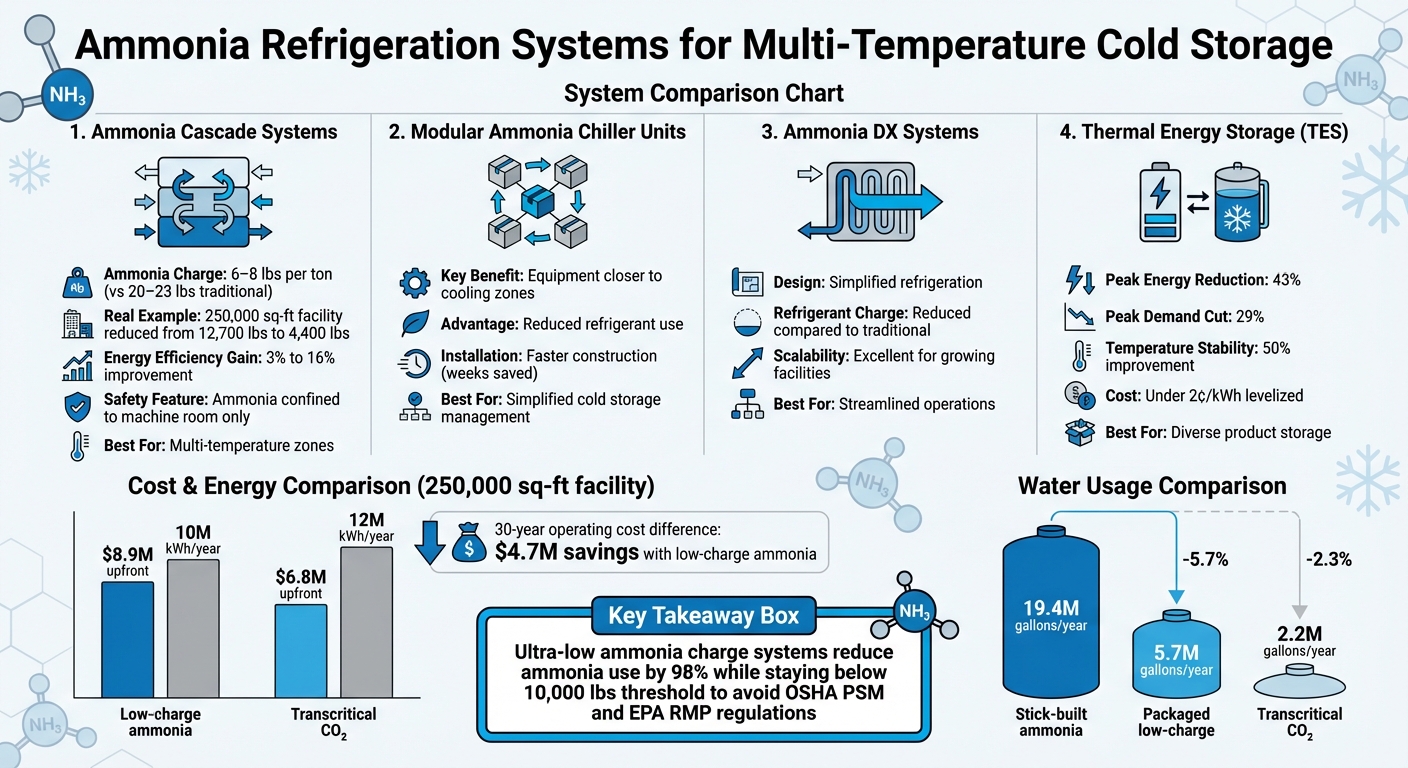
Ammonia Refrigeration Systems Comparison: Energy Efficiency and Cost Analysis
Industrial Refrigeration system Basics – Ammonia refrigeration working principle
sbb-itb-ac9c73d
1. Ammonia Cascade Systems
Ammonia cascade systems are designed to keep ammonia (NH₃) confined to the machine room, where it condenses CO₂. The CO₂ then circulates to the evaporators throughout the facility. This setup eliminates the need for extensive ammonia piping in areas where people work, while also dramatically lowering the refrigerant charge. For example, while PRL systems need 20–23 lbs of ammonia per ton, cascade systems cut that down to just 6–8 lbs. A real-world example? A 250,000-sq-ft facility reduced its ammonia use from 12,700 lbs to just 4,400 lbs .
Refrigerant Charge (lbs)
Keeping the ammonia charge below 10,000 lbs means you can avoid strict OSHA PSM and EPA RMP regulations. Ultra-low ammonia charge (ULC) refrigeration packages take this even further, cutting ammonia use by more than 98% compared to centralized engine room systems. This not only simplifies compliance but also helps improve energy performance.
Energy Efficiency Gain (%)
Ammonia/CO₂ cascade systems deliver 3% to 16% better energy efficiency than traditional ammonia setups, depending on specific designs and conditions. CO₂ is especially effective for heavy freezer loads operating between -20°F and 0°F because it lowers compressor energy use at these temperatures. This combination of efficiency and precise temperature control makes cascade systems a great fit for multi-temperature food and beverage facilities.
Scalability for Multi-Temperature Zones
Cascade systems shine in multi-temperature environments thanks to CO₂’s high heat transfer efficiency and favorable vapor-to-liquid ratios. These properties allow for smaller evaporators, narrower pipes, and reduced pumping power requirements. Plus, the system operates under positive pressure throughout, eliminating the need for air-purging systems often required in ammonia-only freezers that run under vacuum. Electronic expansion valves further enhance performance by adjusting CO₂ temperature and pressure to meet specific zone requirements. This flexibility makes cascade systems ideal for modular cold storage designs.
Safety Features
Cascade systems prioritize safety by keeping ammonia contained and reducing its overall charge. Michael McGinnis, President of Innovative Refrigeration, highlights this key advantage:
"In a cascade refrigeration application, no ammonia enters the building where product and workers are located. The entire ammonia charge is located and isolated within the equipment room."
This design drastically lowers the risk of ammonia leaks in occupied areas. However, operators must be skilled in maintaining dual compressors and selecting appropriate defrost strategies.
2. Modular Ammonia Chiller Units
<!– wp:html –> <div class="uscb-wrap"> <section class="uscb-intro"> <span class="uscb-label">industry overview</span> <h2>Modular Ammonia Chiller Units Knowledge Hub</h2> <p>Modular ammonia chiller units are changing the way cold storage facilities manage refrigeration. By placing equipment closer to the temperature zones they serve, these systems cut down on refrigerant use, simplify cold storage construction, and improve energy efficiency. In this section, you’ll learn how they work and why they’re gaining traction in the industry.</p>
3. Ammonia DX Systems
<div class="uscb-wrap"> <section class="uscb-intro"> <span class="uscb-label">industry overview</span> <h2>Ammonia DX Systems Knowledge Hub</h2> <p>Ammonia Direct Expansion (DX) systems are changing how cold storage facilities manage refrigeration. By simplifying design and reducing refrigerant use, these systems offer energy efficiency, scalability, and enhanced safety. Here’s what you need to know about their benefits and applications.</p>
4. Ammonia Systems with Thermal Energy Storage (TES)
Thermal Energy Storage (TES) takes the efficiency of ammonia systems to the next level by storing cooling capacity during off-peak hours and using it when demand peaks. This system relies on high-density polyethylene (HDPE) cells filled with Phase Change Material (PCM), which can be customized for temperatures ranging from -20°F to 32°F (-28°C to 0°C). This flexibility allows TES to serve various temperature zones in a single facility, from ice cream freezers to fresh produce coolers.
Energy Efficiency Gains
In a 93,000-square-foot warehouse in Richmond, CA, TES reduced peak-period energy consumption by 43% and cut peak demand by 29%. The facility shed 300–500 kW for up to 13 hours daily, as ammonia refrigeration systems powered down during expensive peak periods. PCM cells play a key role by absorbing 300 times more heat per pound than frozen food and transferring heat eight times faster. With a levelized cost of energy under 2¢/kWh, TES is an affordable way to manage energy demand without increasing ammonia charges or adding mechanical complexity.
Improved Temperature Stability
The same study found that TES improved temperature stability by 50%. This is especially important for facilities handling multiple temperature zones, such as frozen seafood, ice cream, and fresh produce. With smart controls integrated into ammonia systems, TES enhances food quality while cutting energy use. Plus, since TES doesn’t rely on mechanical components, it provides passive temperature protection even during power outages.
Designed for Multi-Temperature Zones
TES systems work with any ammonia refrigeration setup, whether centralized engine rooms, packaged units, or DX systems. A notable example is a $10 million renovation of a 147,000-square-foot facility in Cidra, Puerto Rico, by Isla Frio Refrigeration Corp. in 2020. This project included 50,000 square feet of frozen storage and was the first to incorporate Viking Cold’s TES technology during the design phase instead of retrofitting.
"Puerto Rico has always been very important to Viking Cold Solutions. Our first warehouse installation was on this beautiful island, and it’s appropriate that our first new cold storage construction project be right here in Cidra, PR." – Paul Robbins, Founder, Viking Cold Solutions
This facility was built to withstand hurricanes, ensuring food safety for days without power – an essential feature given Puerto Rico’s grid challenges. For builders of modular cold storage, integrating TES during the design phase not only cuts emissions and boosts energy flexibility but also aligns with advanced construction practices championed by US Cold Storage Builders. TES complements ammonia systems while introducing new opportunities and considerations, setting the stage for the next section’s deeper dive into these dynamics.
Advantages and Disadvantages
<!– wp:html –> <div class="uscb-wrap"> <section class="uscb-intro"> <span class="uscb-label">industry overview</span> <h2>Refrigeration Systems Knowledge Hub</h2> <p>Choosing the right refrigeration system for your facility is a critical decision. Each system comes with its own set of advantages and trade-offs, from energy efficiency to safety features. This section breaks down the key benefits and challenges of various solutions to help you make an informed choice.</p>
<!– wp:html –>
Conclusion
Packaged low-charge ammonia systems provide excellent long-term value for multi-temperature modular storage facilities. For example, in a 250,000‑sq‑ft facility, these systems cost $8.9 million upfront compared to $6.8 million for transcritical CO₂ systems, while consuming 10 million kWh annually versus 12 million kWh. Over time, this results in notable operational savings.
"After 30 years of operation, the transcritical CO₂ system costs $4.7 million more to operate, and the stick-built ammonia system costs $4.6 million more to operate than the low-charge ammonia solution."
- Kurt Liebendorfer, Vice President at Evapco
System installation speed also matters. In June 2018, Henningsen Cold Storage completed a 100,000‑sq‑ft freezer facility in Grandview, WA, 5–6 weeks faster by choosing a transcritical CO₂ system over traditional ammonia. This decision saved $534,000 on refrigeration system costs, even though the CO₂ system consumed about 22% more energy.
Another key benefit of low-charge systems is simplified regulatory compliance. By keeping ammonia inventory below the 10,000‑lb threshold, facilities avoid OSHA Process Safety Management requirements . This makes these systems especially appealing for turnkey cold storage projects.
Water and sewage costs also come into play, particularly in regions with scarce water resources. Stick-built ammonia systems use approximately 19.4 million gallons annually, compared to just 5.7 million gallons for packaged low-charge units and 2.2 million gallons for transcritical CO₂ systems. In dry climates with low wet-bulb temperatures, transcritical CO₂ systems paired with adiabatic cooling can be effective. These factors are essential for optimizing resource use in multi-temperature modular storage.
Ultimately, the best system depends on your facility’s priorities. If energy efficiency and lifecycle costs are top concerns, packaged low-charge ammonia systems are the clear choice. For faster installation and water conservation, transcritical CO₂ may be the better fit. And for reliability at scale, stick-built ammonia systems remain a strong option. Energy consumption – often 60–70% of total operating expenses – should drive these decisions.
At US Cold Storage Builders, we focus on delivering efficient, compliant, and scalable solutions tailored to your facility’s unique needs. By prioritizing long-term performance, we help you achieve optimal results in industrial cold storage construction. <!– /wp:html –>