
<!– wp:html –> <div class="uscb-wrap"> <section class="uscb-intro"> <span class="uscb-label">industry overview</span> <h2>Insulation Systems Knowledge Hub</h2> <p>Keeping precise temperatures in multi-temperature storage facilities isn’t just a goal – it’s a necessity. With nearly 70% of cold storage handling temperature-sensitive goods, the right insulation system directly impacts energy costs and product quality. This guide breaks down the top materials and methods to help you make informed decisions.</p> </section>
<article class="uscb-article" id="article"> <div class="uscb-summary"> <p><strong>At a glance:</strong> Choosing the right insulation ensures energy savings, regulatory compliance, and reduced spoilage.</p> <ul> <li><strong>Material performance:</strong> Compare R-values, costs, and best uses for PIR, PUR, XPS, EPS, and Rock Wool.</li> <li><strong>Installation tips:</strong> Proper sealing, joint systems, and sub-slab heating improve efficiency.</li> <li><strong>Maintenance strategies:</strong> Regular checks and retrofitting extend lifespan and scalability.</li> </ul> </div>
<div class="uscb-step-title"> <span class="uscb-step">1</span> <h2>Material Performance Overview</h2> </div> <p>When building or upgrading your facility, insulation material matters. Polyisocyanurate (PIR) and Polyurethane (PUR) lead with R-values of 6.5–8.0 per inch, offering thinner walls and better energy efficiency. PIR, while slightly more expensive, can cut power use by 10–25% in deep-freeze zones. For moisture-heavy areas like freezer floors, Extruded Polystyrene (XPS) provides excellent frost resistance with an R-value of 5.0 per inch. Expanded Polystyrene (EPS) is the budget-friendly option, though it requires thicker profiles to meet DOE standards (R-25 for coolers, R-32 for freezers).</p> <div class="uscb-quote"> "PIR panels reduce power consumption significantly in facilities operating below –20°C."
<cite> – US Cold Storage Builders</cite> </div>
<div class="uscb-step-title"> <span class="uscb-step">2</span> <h2>Installation Techniques for Efficiency</h2> </div> <p>Even the best materials fail without proper installation. Airtight joints – like cam-lock panels – outperform tongue-and-groove systems, ensuring air leakage stays below 0.05 m³/h·m² at 50 Pa. For freezer floors, sub-slab heating prevents frost heave, while high-speed doors reduce infiltration in high-traffic areas. Before commissioning, thermal imaging should confirm consistent R-values across seams.</p> <div class="uscb-quote"> "A poorly sealed system can undermine even the highest insulation ratings."
<cite> – American Insulated Panel</cite> </div>
<div class="uscb-step-title"> <span class="uscb-step">3</span> <h2>Maintenance and Retrofitting</h2> </div> <p>Regular inspections keep your system efficient. Check for gaps over 1 mm in panel joints and reseal with polyurethane foam. Retrofitting older facilities with PIR panels can improve freezer efficiency by 10–25%, with costs ranging from $20–$40 per square foot. Modular panels also simplify expansions, allowing you to adapt to changing storage needs without major disruptions.</p> <div class="uscb-quote"> "Modular systems cut construction time by up to 40% and offer flexibility for future growth."
<cite> – US Cold Storage Builders</cite> </div>
<h3>Conclusion</h3> <p>Insulation in multi-temperature storage isn’t just about meeting minimum R-values. It’s about balancing performance, cost, and scalability to protect your products and your bottom line. From PIR’s energy savings to XPS’s moisture resistance, each material has its place. Proper installation and maintenance ensure your facility stays efficient for years to come. For expert guidance, US Cold Storage Builders has you covered.</p> </article>
<section class="uscb-dark"> <span class="uscb-label">industry insights</span> <h2>Top Insights for Cold Storage Insulation</h2> <div class="uscb-grid"> <div class="uscb-card"> <div class="uscb-card-icon">❄️</div> <h3>Energy Savings</h3> <p>PIR panels reduce energy consumption by up to 25% in deep-freeze environments.</p> </div> <div class="uscb-card"> <div class="uscb-card-icon">🛠️</div> <h3>Faster Construction</h3> <p>Modular panels cut build times by 40%, saving time and labor costs.</p> </div> <div class="uscb-card"> <div class="uscb-card-icon">🌡️</div> <h3>Better Temperature Control</h3> <p>Airtight cam-lock joints maintain consistent R-values, reducing product spoilage.</p> </div> <div class="uscb-card"> <div class="uscb-card-icon">💧</div> <h3>Moisture Resistance</h3> <p>XPS insulation excels in high-moisture areas like freezer floors.</p> </div> <div class="uscb-card"> <div class="uscb-card-icon">🔧</div> <h3>Easy Retrofitting</h3> <p>Upgrading with PIR panels improves efficiency without major disruptions.</p> </div> <div class="uscb-card"> <div class="uscb-card-icon">📊</div> <h3>Regulatory Compliance</h3> <p>DOE mandates R-25 for coolers and R-32 for freezers – modular panels meet these standards.</p> </div> </div> <p class="uscb-dark-note">Optimize your facility with these proven strategies.</p> </section>
<section style="background:#fff;padding:80px 40px;"> <div class="uscb-faq"> <span class="uscb-label">frequently asked questions</span> <h2>FAQ – Insulation for Multi-Temperature Storage</h2> <div class="uscb-faq-item"> <h3>What is the best insulation for freezers?</h3> <p>PIR and PUR panels offer the highest R-values and energy efficiency for freezers operating at –20°F or lower.</p> </div> <div class="uscb-faq-item"> <h3>How can I prevent frost heave in freezer floors?</h3> <p>Use XPS insulation with sub-slab heating systems to prevent frost buildup and maintain structural stability.</p> </div> <div class="uscb-faq-item"> <h3>How often should insulation systems be inspected?</h3> <p>Inspect joints, seals, and panels annually to ensure efficiency and compliance with temperature standards.</p> </div> </div> </section>
<section class="uscb-cta"> <h2>Build Smarter Cold Storage Solutions</h2> <p>US Cold Storage Builders specializes in energy-efficient, modular panel systems tailored to your needs.</p> <a href="tel:3466765653" class="uscb-btn">📞 Call (346) 676-COLD</a> </section> </div> <!– /wp:html –>
Cold Storage Insulated Panels: Thermal efficiency and lower operation costs
sbb-itb-ac9c73d
Top Insulation Systems for Multi-Temperature Storage
<!– wp:html –> <div class="uscb-wrap"> <section class="uscb-intro"> <span class="uscb-label">industry overview</span> <h2>Top Insulation Systems for Multi-Temperature Storage</h2> <p>Choosing the right insulation system is critical for maintaining efficiency and managing costs in multi-temperature storage facilities. Each material offers specific benefits tailored to different cold storage needs. This guide breaks down the top insulation systems and their applications.</p>
Performance Comparison of Insulation Systems
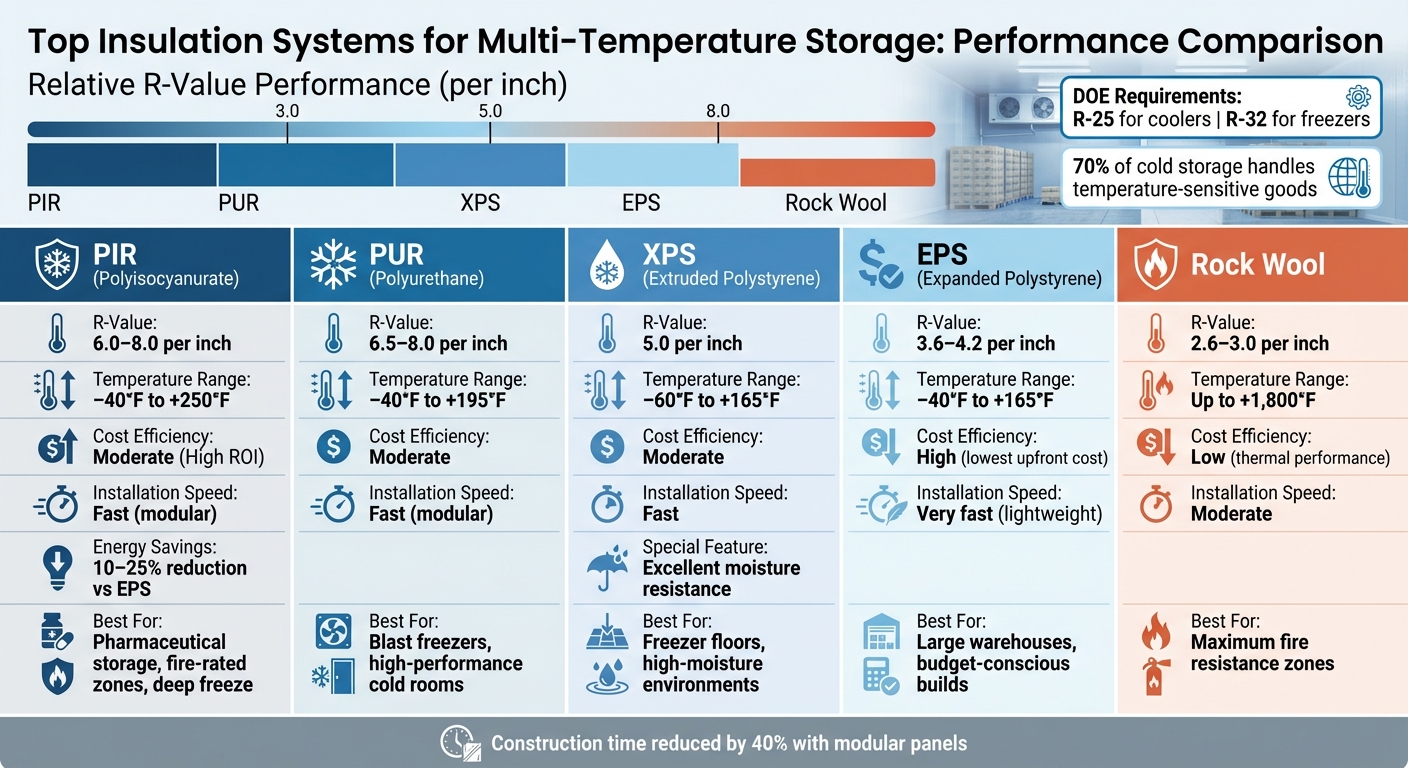
Cold Storage Insulation Materials Comparison Chart: R-Values, Costs, and Best Applications
When choosing insulation for multi-temperature storage, it’s crucial to weigh initial costs against long-term energy savings. This becomes even more important when managing multiple temperature zones within one facility. Below, we dive into the performance details to help you make informed decisions.
Polyurethane (PUR) and Polyisocyanurate (PIR) stand out with R-values between 6.5–8.0 per inch and thermal conductivity ranging from 0.018 to 0.022 W/m·K. These materials allow for thinner walls without sacrificing thermal efficiency. PIR panels, while 10–15% more expensive than PUR due to additional flame retardants and complex production, can reduce power consumption by 10–25% for facilities operating at –20°C (–4°F) compared to EPS panels.
Extruded Polystyrene (XPS) offers an R-value of about 5.0 per inch. Its closed-cell structure provides excellent moisture resistance, making it ideal for freezer floors where frost-heave prevention is critical. On the other hand, Expanded Polystyrene (EPS), with R-values between 3.6 and 4.2 per inch, is a budget-friendly option. While it requires thicker profiles, its lightweight nature speeds up installation and reduces labor costs.
The Department of Energy (DOE) mandates minimum R-values of R-25 for coolers and R-32 for freezers, setting a baseline for compliance. Modular panels, which ensure airtightness below 0.1 m³/h·m² at 50 Pa, can also cut construction time by up to 40%.
Performance Metrics Table
Here’s how the leading insulation systems stack up:
| Insulation Material | R-Value per Inch | Temperature Range | Cost Efficiency | Installation Speed | Best Application |
|---|---|---|---|---|---|
| PIR (Polyisocyanurate) | 6.0–8.0 | –40°F to +250°F | Moderate (high ROI) | Fast (modular) | Pharmaceutical storage, fire-rated zones, deep freeze |
| PUR (Polyurethane) | 6.5–8.0 | –40°F to +195°F | Moderate | Fast (modular) | Blast freezers, high-performance cold rooms |
| XPS (Extruded Polystyrene) | 5.0 | –60°F to +165°F | Moderate | Fast | Freezer floors, high-moisture environments |
| EPS (Expanded Polystyrene) | 3.6–4.2 | –40°F to +165°F | High (lowest upfront) | Very fast (lightweight) | Large warehouses, budget-conscious builds |
| Rock Wool | 2.6–3.0 | Up to +1,800°F | Low (thermal) | Moderate | Maximum fire resistance zones |
This breakdown helps cold storage builders match insulation materials to their specific project needs, ensuring both efficiency and compliance.
Best Practices for Insulated Panel Systems
Material Selection and Engineering
Choosing the right materials is the foundation of an efficient insulated panel system. For example, panel thickness should align with temperature needs: 50–75 mm for chill rooms (above 32°F), 100–150 mm for freezers (0°F), and 150–200 mm for ultra-low temperature storage (below –22°F). This ensures compliance with DOE R-value requirements while preventing issues like frost heave.
Joint systems also play a big role. Cam-lock panels, using zinc-coated steel hooks, create mechanical joints with airtightness under 0.05 m³/h·m² at 50 Pa – far better than tongue-and-groove systems. These joints are especially effective for pharmaceutical storage or facilities with frequent temperature changes, offering durability and easier reconfiguration.
Regulatory standards further guide material choices. For hygiene-critical environments, FDA and EU food-grade coatings are essential, while FM 4880 certification ensures fire safety. In pharmaceutical settings, WHO and USP <1079> standards often require specific finishes like stainless steel for washdown areas or embossed aluminum for impact resistance. PIR panels meet these demands, offering fire resistance up to B-s2,d0 (EN 13501-1) and operating continuously at 248°F (120°C).
Installation Techniques for Energy Efficiency
Even the best materials can fail without proper installation.
"A poorly sealed panel system can undermine even the highest insulation rating." – American Insulated Panel
Penetrations for electrical conduits, piping, and HVAC ductwork must be sealed with closed-cell foam gaskets or polyurethane sealants to preserve the vapor barrier. Panel bundles should be stored drip nose down, and spreader bars should be used to avoid damage and hidden air gaps.
Continuous insulated metal panel (IMP) envelopes help eliminate thermal bridging, reducing HVAC loads by up to 50%. This not only cuts energy costs but can also lower product spoilage rates by 20–30%. For freezer floors, sub-slab heating (glycol or electric) prevents frost heave and ensures structural stability.
Doorways are another weak point in thermal envelopes. High-speed, tight-sealing doors paired with vestibules minimize air infiltration at high-traffic areas. Before commissioning, thermal imaging can verify that seams meet the expected R-value in practice. With temperature-sensitive products making up nearly 70% of the global cold storage market, precise installation is non-negotiable.
Maintenance and Retrofitting for Scalability
Maintenance and smart design keep systems running efficiently over time.
Modular panel systems can cut construction time by up to 40% compared to masonry. Their flexibility shines during expansions, as cam-lock joints allow panels to be disassembled and relocated. "Swing rooms", which can shift between +35°F (chilled) and –20°F (frozen), add operational flexibility for facilities managing multiple temperature zones.
Regular inspections are critical. Check joints for gaps over 1 mm and seal them with polyurethane foam or butyl tape. Temperature sensors should be calibrated to within ±0.2°C to meet food and pharmaceutical standards. Some insulation materials may experience thermal drift – gradual R-value loss – highlighting the need for high-quality initial installation.
Planning for future growth during initial construction can save costs later. Extra penetrations or circuits for chillers and evaporators reduce disruption during expansions. Retrofitting older facilities with PIR panels instead of EPS can improve energy efficiency by 10–25% for freezers operating at –4°F, with installation costs ranging from $20 to $40 per square foot .
These strategies, widely adopted by experts like US Cold Storage Builders, ensure scalable, energy-efficient solutions tailored to multi-temperature storage needs.
Conclusion and Key Takeaways
<!– wp:html –> <div class="uscb-wrap"> <section class="uscb-intro"> <span class="uscb-label">industry overview</span> <h2>Insulation Systems for Cold Storage Knowledge Hub</h2> <p>Insulation systems play a crucial role in maintaining temperature control in cold storage facilities. From energy efficiency to fire resistance, each material offers specific benefits tailored to different storage needs. This guide breaks down their features and provides actionable recommendations for effective cold storage construction.</p>