
Refrigerated Warehouse Energy Efficiency Knowledge Hub
Refrigeration consumes up to 80% of total energy in a cold storage facility. That’s not a fixed cost — it’s a controllable one. The right combination of insulation upgrades, drive controls, monitoring systems, lighting, and thermal storage can cut your energy bill by 20–40%, with most investments paying back in under five years.
At a glance: Five strategies account for the largest energy savings in refrigerated warehouses — each targeting a different layer of energy waste:
- High-Performance Insulation: Insulated metal panels (IMPs) deliver R-25 to R-45 vs. R-8 to R-15 for stick-built walls. Typical savings: 15–25% on energy bills.
- Variable Speed Drives (VSDs): Match motor speed to actual demand instead of running at near-full power. Savings: 8–30% on refrigeration energy.
- Smart Monitoring Systems: IoT sensors and AI analytics catch inefficiencies in real time. Savings: 20–30% on refrigeration costs.
- LED Lighting: Cut lighting energy use 40–65% and reduce heat load on refrigeration equipment. Payback: under 1 year in most cases.
- Thermal Energy Storage (TES): Store cold during off-peak hours, run refrigeration equipment idle for up to 13 hours during peak pricing periods. Savings: 25–40%.
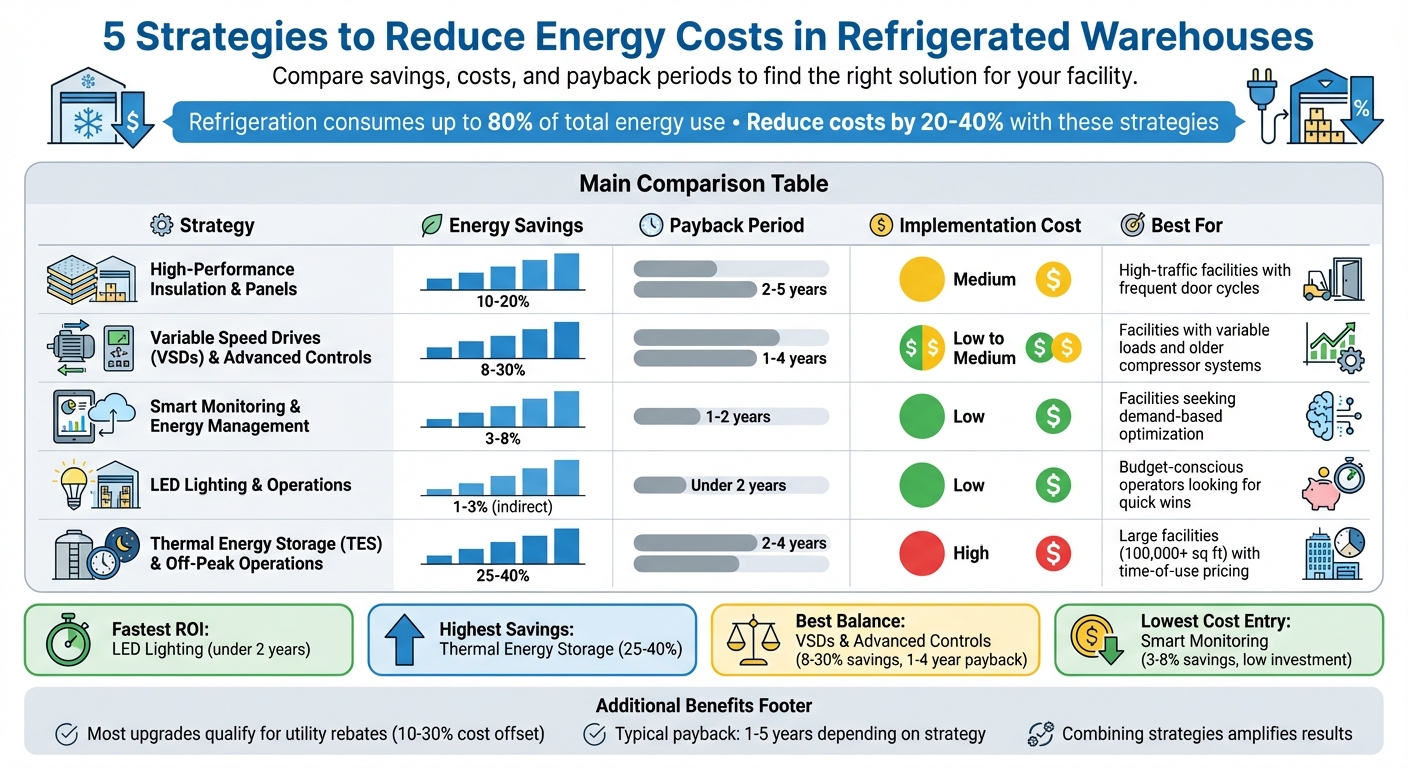
Energy Savings Comparison: 5 Strategies to Reduce Refrigerated Warehouse Costs
1
Poor insulation is a compressor problem. When thermal bridging and air leaks let heat in, compressors run longer, consume more power, and wear out faster. Traditional stick-built walls deliver an effective R-value of just R-8 to R-15 due to thermal bridging at studs and gaps at seams. Insulated metal panels (IMPs) with rigid polyurethane cores deliver R-25 to R-45, depending on thickness.
That difference has a direct dollar value: facilities using IMPs typically see 15–25% lower energy bills compared to stick-built construction. IMPs use interlocking seams — tongue-and-groove or cam-lock systems — that eliminate air leaks and act as vapor barriers. No moisture infiltration means no frost buildup, no mold, and no insulation performance degradation over time. For industries like produce or dairy where refrigeration accounts for up to 80% of total energy use, this matters enormously.
Upgrade to High-Performance Insulation and Insulated Panels
Cost and ROI
IMPs cost more upfront than stick-built — but that math flips by year three. The added electricity and maintenance expenses of stick-built warehouses typically exceed the initial cost savings within that window. Utility rebates and government programs like the Inflation Reduction Act or local initiatives like Mass Save can significantly offset the investment. High-performance insulated panels typically pay for themselves within three to four years through energy savings and reduced maintenance, with additional benefits from longer compressor lifespans and eliminated mold remediation risk.Implementation Notes
IMPs are designed for quick installation with minimal downtime during retrofits. Seal joints with approved sealants; close gaps using weather stripping, caulking, or closed-cell spray foam for airtight continuity. If retrofits involve increasing wall height, coordinate adjustments with racking systems, fire protection setups, and slab tolerances. Model energy consumption over a 5–10 year period to fully capture the ROI — lower bills, less equipment wear, and reduced downtime compound over time.
2
Traditional fixed-speed motors are inherently wasteful. A screw compressor running at 60% capacity with conventional controls still draws about 80% of full power. With a Variable Speed Drive (VSD), that same compressor at 60% capacity draws 60% power. That gap — 20 percentage points — represents pure waste in every hour your compressor runs below full load.
Advanced refrigeration controls compound the savings further by optimizing defrost cycles and adjusting head pressure based on ambient conditions, adding up to 10% additional savings.
Install Variable Speed Drives and Advanced Refrigeration Controls
“An integrated approach to optimizing the mechanical system — along with an automation strategy — is one of the most effective ways to reduce energy costs.”
— Luke Facemyer, Director of Design, Stellar
Proven Results
In September 2014, a Canadian facility using a 315 kW Mycom screw compressor switched from traditional to Danfoss VLT drive controls. At 80% capacity, energy consumption dropped 15% — saving 292,365 kWh annually and $1,461,825 per year. The $1.4 million installation cost was recovered in under a year. A poultry processing plant in Northern Spain spent $1.6 million on VSDs and advanced controls in 2023, cut electricity use by 26% (2.1 GWh/year), and saved approximately $320,000 annually, with a 4.8-year payback.Savings Breakdown
Refrigeration accounts for 60–80% of total energy use in cold storage warehouses. Compressor VSDs alone deliver 8–15% electricity savings. Floating head pressure controls add another 5–10%. Demand-based defrost controls reduce defrost energy use by 20–40%, contributing 3–8% in overall savings. Even raising suction pressure by 1°F results in 1.5% energy savings for compressors.Cost and ROI
A full upgrade — VSDs, advanced controls, and related improvements — typically costs $1.7M–$2.4M for a medium-sized facility. Utility rebates and incentives can offset 10–30% of costs. Before proceeding, confirm motors are inverter-duty rated — standard motors can fail prematurely under VSD pulse-width modulation. Payback periods: compressor VSDs in 2.5–4 years, floating head pressure controls in 1–3 years, optimized defrost systems in 1–2 years. Comprehensive multi-measure projects average a 3.2-year median payback.
3
You can’t fix what you can’t see. Wireless IoT sensors track temperature, humidity, and energy use at the circuit level, feeding data into cloud dashboards that send automated alerts when thresholds are crossed. AI-driven analytics detect problems — dirty condenser coils, refrigerant leaks — by analyzing compressor runtimes and cycles before those problems become failures. Digital compliance logging creates audit trails that meet HACCP and FSMA standards, saving approximately $2,700 per location annually in compliance labor.
Use Smart Monitoring and Energy Management Systems
“The difference between a facility that monitors and one that does not often comes down to $10,000–$30,000 per year in preventable maintenance and energy costs.”
— Envigilance
Energy Savings Potential
Smart monitoring systems cut refrigeration energy costs by 20–30%. The mechanism is straightforward: lowering a setpoint even one degree below required temperature wastes 2–4% more energy. Dirty condenser coils drive up energy use by 15–25%. Given that refrigeration accounts for 60–70% of total cold storage energy use, catching either of those issues early generates substantial savings. Predictive maintenance enabled by these systems cuts total maintenance expenses by 25–40%.Cost and ROI
Traditional building management systems (BMS) cost $50,000–$200,000+ and take 3–6 months to deploy. A Monitoring-as-a-Service (MaaS) model starts at around $750/month with no upfront investment and deploys in 10 days. Most facilities see payback within 3–6 months. Some multi-site retailers report a 5:1 ROI in the first year. Beyond energy, these systems reduce labor costs, minimize inventory losses, and extend equipment life.
“Every dollar saved on energy in a grocery store is equivalent to increasing sales by $59 due to the industry’s razor-thin profit margins.”
— ENERGY STAR
4
Traditional metal halide and high-pressure sodium fixtures lose up to 90% of energy as heat. In a cold storage facility, that heat goes straight into your refrigeration load — your compressors have to remove it. LEDs generate approximately 120°F compared to 300°F for metal halides, directly reducing the thermal burden on refrigeration equipment.
Switch to LED Lighting and Improve Daily Operations
“Replacing metal halides with equivalent LED fixtures can reduce energy usage up to 50%. In cold storage, however, the energy savings extend beyond the fixtures themselves.”
— Josh Kegley
LEDs maintain over 95% output at -5°F — they don’t need the 10–20 minute warm-up period that fluorescent and HID lamps require. In dark freezer aisles, that instant-on capability matters for forklift operator safety. Adding occupancy sensors in low-traffic areas can reduce energy use in those zones by more than 90%, with no impact on LED lifespan from frequent cycling.
Real-World Numbers
A 200,000 sq ft warehouse running 24/7 that replaces 400W metal halide fixtures with 150W LEDs saves approximately 674,160 kWh annually — or $74,158 at $0.11/kWh. United States Cold Storage in Hazleton, PA replaced 465W high-pressure sodium lamps with 160W intelligent LEDs, slashing energy costs from $0.46 to $0.035 per sq ft per year — a 93% reduction. In March 2024, a 250,000 sq ft Ontario, California facility replaced 312 metal halide fixtures with 180W LED high-bays. Total project cost was $87,360 before rebates; utility incentives brought net cost to $68,640. Annual energy savings: $74,650. Payback: 7.8 months.Cost and ROI
LED high-bay fixtures (150W) run $95–$165 per unit in bulk. Installation labor is $45–$85 per fixture for direct replacements, $120–$220 if new wiring is required. Wireless controls add $45–$90 per fixture. Overall retrofit cost: approximately $0.21–$0.35 per sq ft. Utility rebate programs typically cover $20–$80 per fixture, reducing total investment by 15–30%. LED lifespans of 50,000–100,000 hours versus 10,000–20,000 hours for HID lamps mean maintenance savings contribute an additional 15–25% of overall project value.
5
Peak electricity pricing can account for up to 70% of a facility’s energy costs — even though peak hours represent a fraction of the operating day. Thermal Energy Storage (TES) systems solve this by storing cold during off-peak hours when electricity rates are lower, then using that stored cold during expensive peak periods while refrigeration equipment sits idle.
TES relies on phase change materials (PCM) that absorb up to 300 times more heat per pound than frozen food and transfer heat eight times faster. This allows refrigeration equipment to remain idle for up to 13 hours during high-cost periods without risking product temperature.
Use Thermal Energy Storage and Off-Peak Operations
“By adding Thermal Energy Storage (TES)… operators utilizing a ‘limited run time strategy’ can maintain temperature requirements with refrigeration equipment idle up to 13 hours or longer without risking food quality.”
— Viking Cold Solutions
Proven Results
A 93,000 sq ft frozen food warehouse in California installed TES and reduced peak-period energy use by 43%, cutting overall demand by 29% on weekdays. The San Diego Food Bank paired TES with solar power, reducing overnight grid-sourced refrigeration by 95% and lowering annual refrigeration energy costs by 39%. The levelized cost of energy for TES systems is under 2 cents per kWh.System Options and Cost
Three TES approaches exist at different price points: static thermal mass (controls-only, lowest cost, best for facilities over 100,000 sq ft), phase change materials (internal hardware, moderate cost, suited for smaller spaces), and external storage systems (extensive infrastructure, highest cost). Upfront costs run 25–40% higher than traditional refrigeration systems, but utilities like PG&E and Southern California Edison offer incentives to offset the investment. Payback periods typically run 2–4 years, with reported energy cost reductions of 25–40%.
6
Strategy Comparison and How to Choose
| Strategy | Energy Savings | Typical Payback | Implementation Cost | Best For |
|---|---|---|---|---|
| High-Performance Insulation | 10–20% | 2–5 years | Medium | High-traffic facilities with frequent door cycles |
| VSDs & Advanced Controls | 8–30% | 1–4 years | Low to medium | Facilities with variable loads and older compressor systems |
| Smart Monitoring | 3–8% | 1–2 years | Low | Facilities seeking demand-based optimization |
| LED Lighting | 1–3% (indirect) | Under 2 years | Low | Budget-conscious operators looking for quick wins |
| Thermal Energy Storage | 25–40% | 2–4 years | High | Large facilities (100,000+ sq ft) with time-of-use pricing |
Conclusion
Energy costs are the largest controllable expense in refrigerated warehousing. The five strategies covered here — insulation, VSDs, monitoring, LEDs, and TES — each target a different layer of energy waste, and they compound when combined. Facilities that adopt these solutions typically achieve 10–30% annual energy savings; TES-equipped operations have reported reductions exceeding 35%.
“As energy costs continue to rise, investing in energy efficiency measures will be increasingly important for the long-term success and sustainability of refrigerated warehousing operations.”
— Dave McGowan, WEL Companies
Start with an energy audit to identify your highest-consumption areas — evaporator fan motors and condensing units are typically first. Prioritize upgrades with the fastest payback: LED lighting, air leak sealing, and VSD installation. For facilities over 100,000 sq ft on time-of-use pricing, TES is the highest-leverage investment available. Monitor temperature and energy data monthly — door seals, insulation, and evaporator coils degrade over time, and catching that degradation early prevents compressors from silently compensating for it at your expense.
US Cold Storage Builders designs and builds energy-efficient cold storage facilities from the ground up — integrating high-performance insulated panels, refrigeration systems, and smart building controls into every project across the United States.
frequently asked questions