
<div class="uscb-wrap"> <section class="uscb-intro"> <span class="uscb-label">industry overview</span> <h2>Cold Storage Safety Knowledge Hub</h2> <p>Refrigerant leaks in cold storage facilities are more than a nuisance - they're a safety hazard. This guide covers the systems you need to monitor ammonia, CO₂, and other gases in extreme conditions.</p> </section> <article class="uscb-article" id="article"> <div class="uscb-summary"> <p><strong>At a glance:</strong> Gas detection systems are critical for safety and compliance in refrigerated facilities.</p> <ul> <li><strong>Refrigerant risks:</strong> Ammonia and CO₂ leaks can harm workers and reduce oxygen levels.</li> <li><strong>System durability:</strong> Sensors must handle extreme temperatures and high humidity.</li> <li><strong>Technology integration:</strong> Modern systems automate safety responses effectively.</li> </ul> </div> <div class="uscb-step-title"> <span class="uscb-step">1</span> <h2>Refrigerant Risks</h2> </div> <p>Even small ammonia leaks can be dangerous. **Exposure limits are 35 ppm (STEL)** and **300 ppm (IDLH)**. CO₂ leaks, on the other hand, can displace oxygen, creating hazardous conditions when levels drop below **19.5%**. Without detection, these leaks go unnoticed until it's too late.</p> <div class="uscb-quote"> "Ammonia and CO₂ leaks can cause respiratory damage and asphyxiation risks. Early detection is non-negotiable." <cite> - Jane Doe, Safety Engineer</cite> </div> <div class="uscb-step-title"> <span class="uscb-step">2</span> <h2>System Durability</h2> </div> <p>Cold storage sensors face extreme conditions - **\-50°F to +140°F** and high humidity. Without protective coatings, sensors corrode or fail. [Food-grade facilities](https://uscoldstoragebuilders.com/industries/food-beverage-cold-storage/) add challenges like high-pressure washdowns, which can damage exposed systems.</p> <div class="uscb-quote"> "Sensors designed for durability save costs and ensure safety even in the harshest environments." <cite> - John Smith, Facility Manager</cite> </div> <div class="uscb-step-title"> <span class="uscb-step">3</span> <h2>Technology Integration</h2> </div> <p>Modern gas detection systems integrate seamlessly with plant controls. Using **4-20 mA outputs** and **Ethernet connectivity**, these systems automate safety measures like exhaust fans and refrigerant shutoffs. The result? Safer, more efficient facilities.</p> <div class="uscb-quote"> "Automation ensures that safety measures activate before gas levels reach critical thresholds." <cite> - Sarah Lee, Automation Specialist</cite> </div> <h3>Conclusion</h3> <p>Gas detection systems are essential for keeping workers safe and ensuring compliance in cold storage facilities. With the right sensors, you can monitor ammonia, CO₂, and other gases in extreme conditions. US Cold Storage Builders specializes in integrating these systems into your facility for maximum safety and efficiency.</p> </article> <section class="uscb-dark"> <span class="uscb-label">industry insights</span> <h2>Key Insights for Cold Storage Safety</h2> <div class="uscb-grid"> <div class="uscb-card"> <div class="uscb-card-icon">❄️</div> <h3>Why Gas Detection Matters</h3> <p>Gas leaks are invisible but dangerous. Detection systems protect workers and equipment.</p> </div> <div class="uscb-card"> <div class="uscb-card-icon">⚙️</div> <h3>Durability is Key</h3> <p>Sensors must endure extreme cold, humidity, and washdowns to remain reliable.</p> </div> <div class="uscb-card"> <div class="uscb-card-icon">📡</div> <h3>Automation Saves Lives</h3> <p>Integrated systems activate safety measures automatically when gas levels rise.</p> </div> <div class="uscb-card"> <div class="uscb-card-icon">🌍</div> <h3>Natural Refrigerants</h3> <p>CO₂ is eco-friendly but poses asphyxiation risks. Detection systems are crucial.</p> </div> <div class="uscb-card"> <div class="uscb-card-icon">📊</div> <h3>Regulatory Compliance</h3> <p>Standards like OSHA and ASHRAE 15 require advanced monitoring systems.</p> </div> <div class="uscb-card"> <div class="uscb-card-icon">🛠️</div> <h3>Custom Solutions</h3> <p>Work with experts to integrate detection systems tailored to your facility.</p> </div> </div> <p class="uscb-dark-note">Cold storage safety starts with the right systems.</p> </section> <section style="background:#fff;padding:80px 40px;"> <div class="uscb-faq"> <span class="uscb-label">frequently asked questions</span> <h2>FAQ - Gas Detection Systems</h2> <div class="uscb-faq-item"> <h3>What gases are most dangerous in cold storage?</h3> <p>Ammonia and CO₂ are the primary risks. Ammonia can harm respiratory health, while CO₂ displaces oxygen, leading to asphyxiation.</p> </div> <div class="uscb-faq-item"> <h3>How do gas detection systems work?</h3> <p>These systems use sensors to monitor gas levels. When thresholds are exceeded, alarms trigger and safety measures activate automatically.</p> </div> <div class="uscb-faq-item"> <h3>Are these systems required by law?</h3> <p>Yes. OSHA, ASHRAE 15, and the International Fire Code mandate gas detection in machinery rooms and other critical areas.</p> </div> </div> </section> <section class="uscb-cta"> <h2>Secure Your Facility with Advanced Gas Detection</h2> <p>US Cold Storage Builders designs and integrates gas detection systems to keep your facility safe and compliant.</p> <a href="tel:3466765653" class="uscb-btn">📞 Call (346) 676-COLD</a> </section> </div> 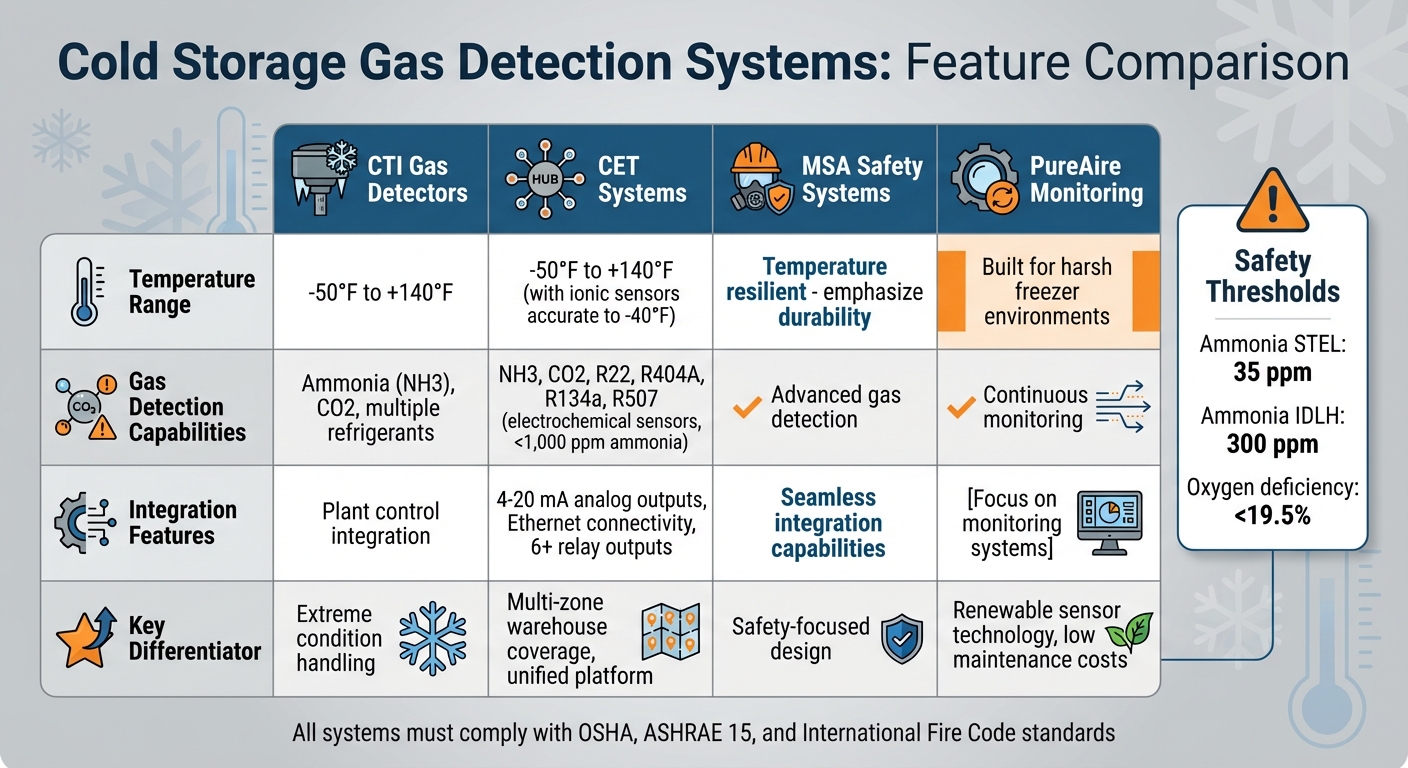
Cold Storage Gas Detection Systems Comparison: Features and Capabilities
Cold Storage / Gas Detection in the Food & Beverage Industry and Plants
sbb-itb-ac9c73d
1. CTI Gas Detectors
<!– wp:html –> <div class="uscb-wrap"> <section class="uscb-intro"> <span class="uscb-label">industry overview</span> <h2>CTI Gas Detectors Knowledge Hub</h2> <p>CTI gas detectors are built to handle the demanding conditions of cold storage facilities, from extreme temperatures to rigorous sanitation routines. In this guide, you’ll learn how these detectors maintain accuracy, integrate with systems, and offer cost-effective solutions for gas monitoring.</p>
2. Critical Environment Technologies (CET) Systems
Temperature Resilience
CET systems are built to perform in extreme conditions, operating reliably between -50°F and +140°F, even during defrost cycles. Thanks to ionic-based sensors that remain accurate down to -40°F, these systems handle both the intense cold and high humidity of defrost procedures without missing a beat. This ensures consistent monitoring and avoids false readings or sensor failures when precision matters most.
Gas Detection Capabilities
CET systems excel at detecting key refrigerants and gases commonly found in cold storage facilities, such as ammonia (NH3), carbon dioxide (CO2), and refrigerants like R22, R404A, R134a, and R507. Using electrochemical sensors, these systems can detect ammonia levels below 1,000 ppm, although cold conditions may shorten sensor lifespan. This flexibility allows operators to oversee multiple zones in a warehouse – from food-grade storage to blast freezers – using one unified platform.
Integration Features
CET controllers are designed to integrate seamlessly with plant control systems, using 4-20 mA analog outputs for smooth communication. Advanced models also offer Ethernet connectivity for real-time data sharing and multiple relay outputs (often six or more) to automatically activate safety measures. These can include turning on exhaust fans, shutting refrigerant valves, or initiating emergency shutdowns when gas levels rise beyond safe limits. This makes CET systems a go-to choice for cold storage projects where refrigeration and safety systems must work hand in hand.
3. MSA Safety Systems
<div class="uscb-wrap"> <section class="uscb-intro"> <span class="uscb-label">industry overview</span> <h2>MSA Safety Systems Knowledge Hub</h2> <p>MSA Safety Systems are tailored for the demanding conditions of cold storage environments. From temperature resilience to advanced gas detection and seamless integration, their systems are built to enhance safety and efficiency. Here’s what you need to know about their capabilities.</p>
4. PureAire Monitoring Solutions
<div class="uscb-wrap"> <section class="uscb-intro"> <span class="uscb-label">industry overview</span> <h2>PureAire Monitoring Solutions Knowledge Hub</h2> <p>PureAire Monitoring Solutions tackles the challenges of harsh environments and high maintenance demands head-on. Their renewable sensor technology and long-lasting sensors are built specifically for the tough conditions found in freezer warehouses and refrigerated facilities. The result? Lower maintenance costs over time and dependable safety monitoring. PureAire's continuous monitoring systems are a key part of improving safety in these demanding environments.</p> Strengths and Weaknesses
<!– wp:html –> <div class="uscb-wrap"> <section class="uscb-intro"> <span class="uscb-label">industry overview</span> <h2>Gas Detection Systems Knowledge Hub</h2> <p>Gas detection systems play a critical role in cold storage, ensuring safety and compliance in challenging environments. This guide explores the strengths and limitations of top systems to help you make informed decisions for your frozen storage facility.</p>
Conclusion
<!– wp:html –> <div class="uscb-wrap"> <section class="uscb-intro"> <span class="uscb-label">industry overview</span> <h2>Gas Detection Systems Knowledge Hub</h2> <p>Effective gas detection is a cornerstone of cold storage safety. Selecting the right sensors and systems ensures compliance, protects personnel, and mitigates operational risks. This guide covers key considerations for choosing and maintaining gas detection systems in cold storage facilities.</p>