
Modular vs Traditional Cold Storage Knowledge Hub
When deciding between modular and traditional cold storage, the choice boils down to cost, speed, scalability, and efficiency. Get the comparison right before you break ground — the wrong call can cost you millions and years of operational headaches.
At a glance: Modular cold storage completes in 60–90 days at $32–$41/sq. ft. Traditional construction runs $130–$350/sq. ft. and takes 6–14 months. Here’s how they compare across every factor that matters:
- Modular: Faster setup (20–50% quicker), lower energy bills, easy to expand or relocate.
- Traditional: Higher upfront costs, longer timelines, better for complex or permanent custom layouts.
Quick Comparison
| Factor | Modular Cold Storage | Traditional Cold Storage |
|---|---|---|
| Construction Speed | 60–90 days | 6–14 months |
| Cost (Per Sq. Ft.) | $32–$41 | $130–$350 |
| Energy Efficiency | 30–40% lower cooling costs | Higher energy expenses |
| Maintenance | 0.5% of CAPEX annually | 2.5% of CAPEX annually |
| Scalability | Simple to expand or relocate | Complex and expensive |
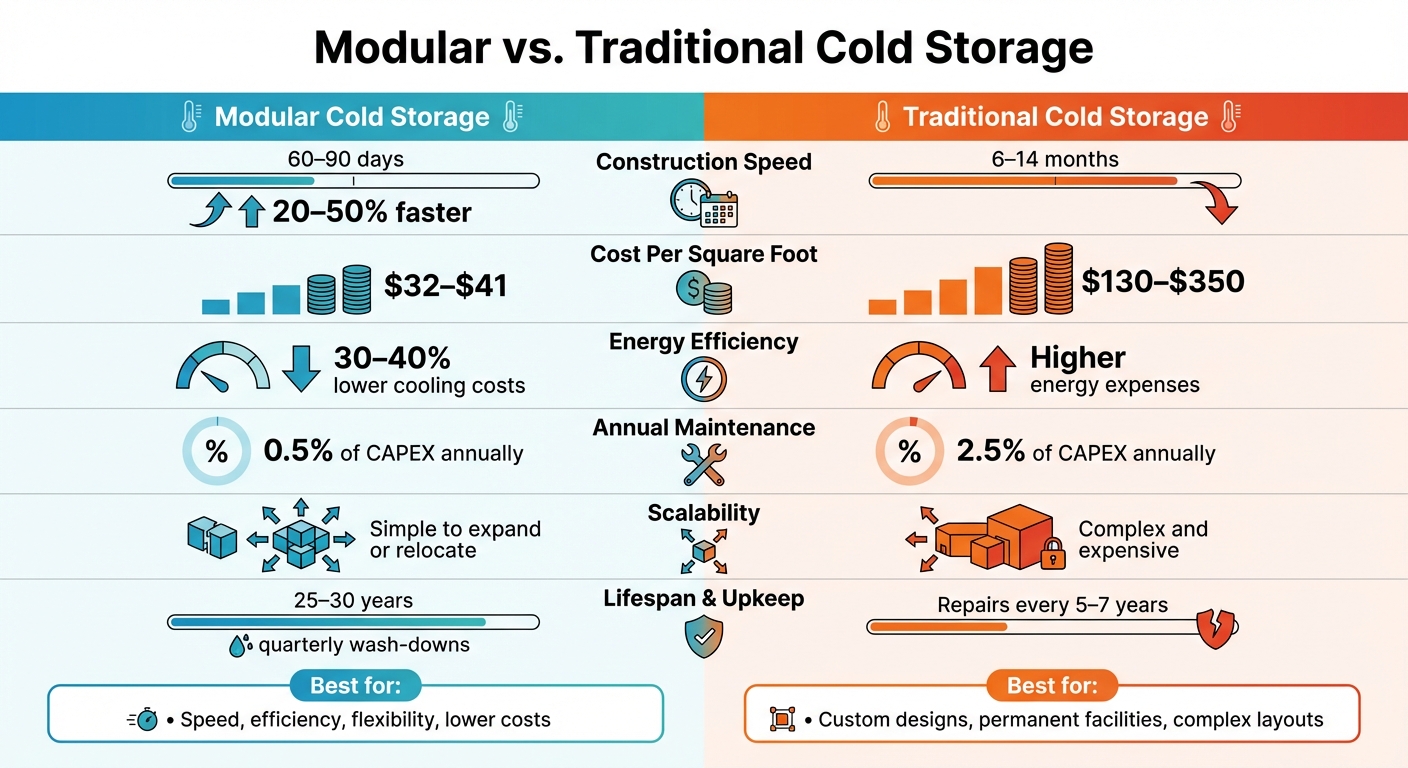
Modular vs Traditional Cold Storage: Cost, Timeline, and Efficiency Comparison
1
Modular Cold Storage
Cost — Upfront and Long-Term
A 6,000 sq. ft. modular facility runs $195,000–$245,000 all-in — steel frame, R-40 insulation, and concrete foundation included. That’s $32–$41 per square foot. The same footprint in traditional concrete construction? $280,000–$340,000. The long-term gap is even wider. High-performance insulated metal panels cut refrigeration loads by 82% compared to uninsulated brick walls, translating to 25–35% lower annual cooling costs. Maintenance averages just 0.5% of CAPEX annually — mostly quarterly wash-downs. Traditional walls require repainting and crack repairs every 5–7 years at 2.5% of CAPEX. Modular panels are built to last 25–30 years with minimal upkeep.Construction Timeline
Pre-engineered modular structures go up and get insulated in 45–90 days. That’s not just faster — it means you’re generating revenue months before a traditional project would even be framed out.Scalability
Modular panels use cam-lock connections, so adding capacity is straightforward. Seasonal demand spikes or long-term growth don’t require major construction events — new sections attach cleanly to existing ones. Many facilities include swing rooms that toggle between chilled (+35°F) and frozen (-20°F) settings based on inventory needs. And if your lease ends or operations move, the entire unit can be disassembled and relocated without losing functionality.Compliance with Standards
Modular units are pre-engineered to meet FDA 21 CFR Part 117 (cGMP), WHO temperature mapping requirements for pharmaceuticals, and DOE energy standards (10 CFR 431). Panels hit R-25 for coolers and R-32 for freezers — meeting federal energy efficiency mandates out of the box. That pre-compliance simplifies permitting and eliminates the risk of expensive mid-project retrofits.
2
Conventional Cold Storage
Cost — Upfront and Long-Term
Traditional cold storage construction ranges from $130 to $350 per square foot — and specialized facilities can hit $812. A mid-sized 30,000 sq. ft. facility runs around $5 million. A 100,000 sq. ft. facility with advanced automation: $12.5–$20 million. Operating costs compound the picture. Energy alone accounts for 60–70% of total operating expenses, with an average of 24.9 kWh per square foot annually. Traditional brick-and-mortar construction allows up to 82% more heat ingress than insulated panels — meaning refrigeration costs run 30–40% higher over the facility’s lifespan. Add 2.5% CAPEX annually for maintenance, insurance premiums 20–30% higher than metal-based structures, and 2–4% of refrigeration system replacement value for mechanical upkeep. It adds up fast.Construction Timeline
Plan for 6 to 14 months from groundbreaking to commissioning — and up to 24 months for large design-build projects. Site preparation alone adds time: these facilities need 6–10x their footprint for truck courts, utility infrastructure, and expansion room. High-capacity refrigeration and automation may also require upgrades to local electrical and water infrastructure before construction even begins.Scalability
Expansion must be designed in from the start. Adding to a traditional facility later means extending heated foundations, continuous vapor barriers, and complex mechanical infrastructure — all requiring meticulous planning and significant capital. Vertical expansion (up to 80–100 feet for high-density operations) helps maximize pallet positions without growing the footprint, but retrofitting existing structures for it is technically demanding and expensive.Compliance with Standards
Traditional facilities must meet FDA 21 CFR Part 117, FSMA, and HACCP requirements. Facilities holding 10,000+ lbs of ammonia must comply with OSHA Process Safety Management (PSM) standards. Many operators also pursue ISO 22000:2018 or GFSI certifications like BRCGS. The unique challenge: maintaining continuous vapor barriers in permanent construction. Improper installation leads to failures within 2–3 years — and retrofitting or expanding makes it even harder to maintain barrier integrity.
3
Modular systems complete projects 20%–50% faster than traditional methods. That speed has a direct revenue impact.
Pros and Cons
“Every week your facility opens early is a week of produce saved, SKUs shipped, or vials validated.”
— Rinac
Factory-built modular systems reduce material waste by up to 50% and eliminate weather-related delays, making costs far more predictable. PIR/PUF insulated panels lower refrigeration costs by 30%–40% versus masonry. Maintenance costs average just 0.5% of CAPEX annually, compared to 2.5% for traditional facilities.
Traditional construction has its own advantages. Lenders view site-built facilities as more reliable assets — though modular financing is improving. And for projects requiring highly customized, complex layouts, traditional methods offer more design flexibility.
| Factor | Modular Cold Storage | Traditional Cold Storage |
|---|---|---|
| Construction Speed | 60–90 days; 20%–50% faster | 6–24 months; phased construction |
| Cost Predictability | High; controlled factory environment | Variable; weather and site delays |
| Energy Efficiency | 30%–40% lower refrigeration costs | Higher heat ingress; insulation upgrades needed |
| Maintenance | Quarterly wash-downs; 0.5% of CAPEX/year | Repairs every 5–7 years; 2.5% of CAPEX/year |
| Flexibility | Relocatable, scalable, reconfigurable | Permanent; expansion requires major work |
| Quality Control | Consistent; factory-controlled precision | Dependent on local labor and site conditions |
Conclusion
If you need a facility in 2–4 months, modular is the only answer. If your project demands a unique, permanent layout and you have the timeline and capital for traditional construction, that option still has a place. Modular systems are ideal for businesses with rapid growth, seasonal swings, or multi-location expansion plans. Traditional construction makes sense when customization, site permanence, or financing structure demands it. The right choice depends entirely on your timeline, operational needs, and growth strategy — not on which method is newer. US Cold Storage Builders builds both modular and traditional cold storage facilities across the United States. If you’re evaluating which approach fits your project, our team can walk you through the real numbers for your specific footprint and use case.
frequently asked questions