
Cold Storage Construction Knowledge Hub
Designing cold storage facilities isn’t just about keeping things cold — it’s about balancing energy efficiency, cost, and safety while meeting strict regulations. Get these 7 design considerations right from the start, and you avoid the costly retrofits and operational failures that come from getting them wrong.
At a glance: Cold storage construction costs 3x more than a standard warehouse — and poor design decisions compound fast. Here’s what you need to get right:
- Site Selection: Choose a location with proper utilities, soil conditions, and proximity to logistics hubs. Optimize building orientation to reduce energy costs.
- Building Envelope: A sealed thermal and vapor barrier is critical. Use high-performance insulation like IMPs or ICFs.
- Refrigeration Systems: Select systems like ammonia or CO₂ based on capacity needs. VFDs and heat recovery systems cut long-term costs.
- Interior Layout: Create temperature zones (ambient, chilled, frozen) to manage energy use. Use airlocks and high-speed doors to control temperature loss.
- Structural Design: Account for thermal expansion, frost heave, and load management. Active sub-floor heating is non-negotiable in freezer facilities.
- Regulatory Compliance: Meet FDA/USDA standards with smooth, cleanable surfaces, proper drainage, and detailed monitoring systems.
- Future Growth: Plan for expansion with scalable utility infrastructure, modular panels, and vertical storage solutions.
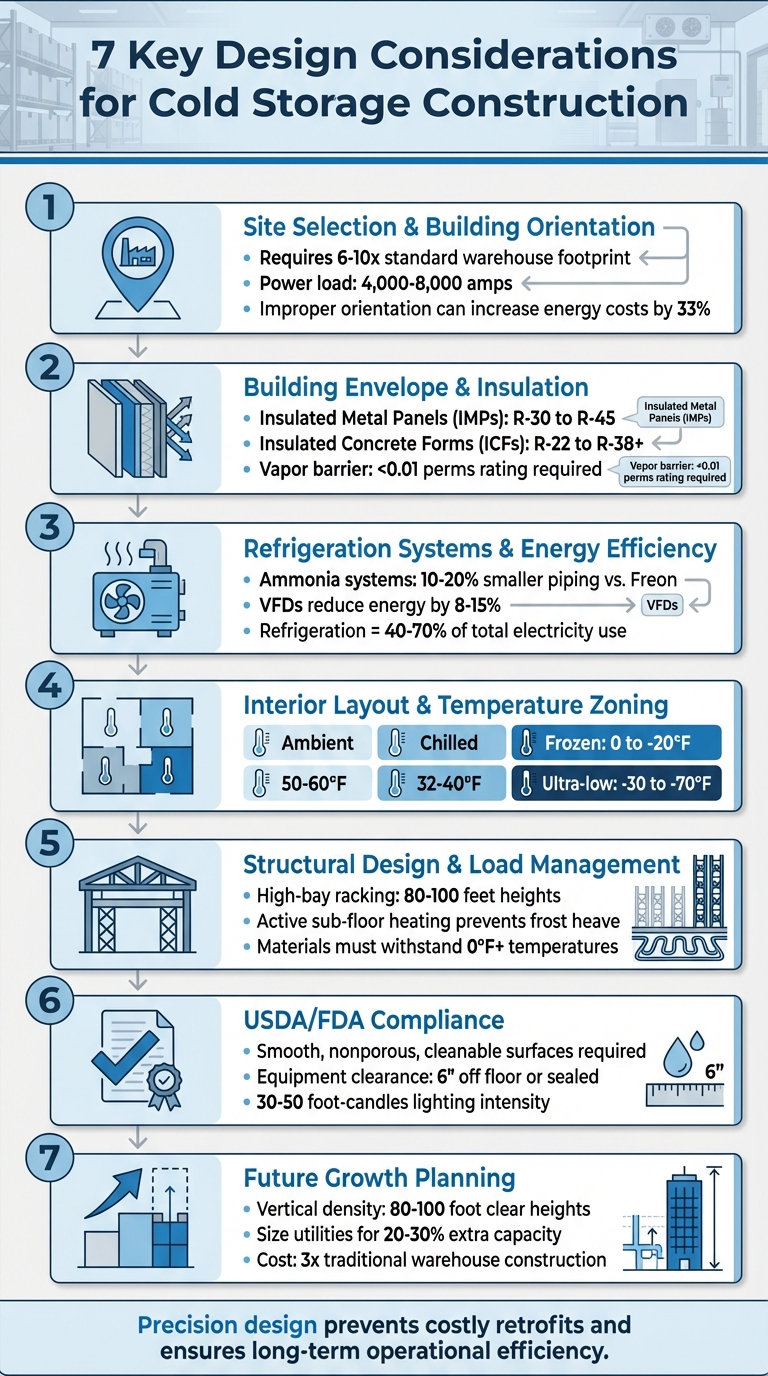
7 Essential Design Considerations for Cold Storage Facility Construction
1
Most people underestimate how much the site itself drives operational costs. Cold storage facilities need 6 to 10 times the building footprint of a standard warehouse — that’s truck courts, trailer staging, temperature-controlled loading zones, and room for a planned 10–20% expansion.
Your utility requirements alone will surprise most developers. These buildings pull 4,000 to 8,000 amps of electrical service — far beyond what a traditional warehouse needs. Get your utility providers involved early, before you finalize the site, or you’ll pay for offsite infrastructure extensions later.
Orientation isn’t just a preference. South-facing walls absorb the most sunlight throughout the day, directly loading your refrigeration system. Improperly oriented buildings see heating and cooling demands rise by as much as 33%. Aligning the building’s shortest side with prevailing winds promotes passive ventilation and cuts energy use. Strategic landscaping — trees, native vegetation — can naturally cool the area around the facility too.
Soil conditions can make or break your budget. Sub-surface ice causes frost heave, which cracks floor slabs and leads to expensive repairs. Run core samples early — before design is locked — to identify soil types and determine whether you’ll need slab heating systems.
Finally, proximity to logistics infrastructure matters. Being close to ports, rail intermodals, or major distribution corridors cuts drayage costs and keeps your cold chain intact. If you need rail access, start the permitting process early — a rail spur can take years to design and approve.
Site Selection and Building Orientation
2
Here’s the thing: your refrigeration system can’t compensate for a bad envelope. The building envelope is your first and most important line of defense against heat transfer. It must form a continuous thermal and vapor barrier across the roof, walls, and floor — no exceptions. Any gap allows heat and moisture in, which leads to ice buildup and structural damage.
Insulated Metal Panels (IMPs) are the industry standard for cold storage walls and ceilings. They’re factory-made, combining steel facings with a rigid polyurethane or PIR core, and deliver R-values from R‑30 to R‑45. In harsher climates, Insulated Concrete Forms (ICFs) — EPS foam blocks filled with concrete — achieve R‑22 to R‑38+.
Building Envelope and Insulation Systems
“Sealing and insulating the building envelope properly to maintain a continuous vapor barrier and reduce heat transfer is mission critical in successful cold storage design.” — Jennifer Carr, Architect, Gresham Smith
Vapor barrier placement is where most mistakes happen. The barrier must go on the warm (exterior) side of the insulation. In the Northeast U.S., the exterior dew point exceeds the internal temperature of a 20°F facility for over 80% of the year. Install it wrong and moisture migrates inward, condenses, and freezes inside your walls. Target a permeance rating below 0.01 perms.
Joint sealing and thermal breaks matter just as much. Seal panel intersections with cam-lock or tongue-and-groove joints using high-performance sealants. Stagger insulation layers to eliminate direct heat paths. At wall-to-roof transitions, foam-in-place insulation fills gaps that rigid board can’t reach. Metal fasteners that penetrate insulation create thermal bridges — reduce their use or switch to stainless steel.
For freezer facilities running below 0°F: install glycol or electric heat-trace systems under the floor insulation. Skip this step and you’re building frost heave into your foundation.
3
Refrigeration is where your operating budget lives. It accounts for 40% to 70% of total electricity consumption in a cold storage facility. The system you choose on day one will determine your energy costs for decades.
For loads over 200 tons, ammonia (NH₃) is the most cost-effective option. It delivers greater latent capacity per pound than synthetic refrigerants and requires 10%–20% smaller piping than Freon. The tradeoff: ammonia is toxic and explosive at concentrations of 16%–25%. Facilities using more than 10,000 lbs must comply with OSHA Process Safety Management (PSM) regulations.
For loads under 100 tons, CO₂ or synthetic refrigerants are more practical. But watch the regulatory calendar — EPA rules effective January 1, 2026 limit refrigerants to a GWP of 150 or lower for systems with 200+ lbs of charge. The industry is moving toward natural refrigerants fast. A Wisconsin dairy facility implemented a 3.2 MW ammonia/CO₂ cascade system in 2024 with integrated heat recovery — saving 18% in electricity and avoiding 2.3 GWh of boiler fuel annually, with a 6.2-year payback.
Variable Frequency Drives (VFDs) cut energy consumption by 8%–15% with 2.5–4 year paybacks. Floating head pressure controls reduce compressor power by 1.5%–3% per 1°C drop in condensing temperature. Inverter-driven compressors are up to 35% more efficient than fixed-speed models. And switching to demand-based defrost sensors cuts defrost energy use by 20%–40% versus fixed schedules.
Heat recovery is often overlooked. Waste heat from compressors and condensers can power glycol slab heating, space heating, or process hot water — potentially eliminating separate gas boilers entirely. Agropur cut energy use by 40% and saved $286,000 annually by upgrading two heat exchangers. Small efficiency gains add up fast when refrigeration is 40%–70% of your electric bill.
Refrigeration Systems and Energy Efficiency
4
Most cold storage facilities run three distinct temperature zones. Get the boundaries wrong and you’re paying to cool space you don’t need to — or worse, compromising product integrity.
Interior Layout and Temperature Zoning
- Ambient staging areas: 50°F to 60°F
- Chilled storage: 32°F to 40°F
- Frozen storage: 0°F to -20°F
- Blast freezer / ultra-low: -30°F to -70°F (specialized products only)
“At openings such as doors and cased openings into refrigerated rooms, cold air can sink and spill out of the cold storage space, which draws warm air into the top of the opening.” — Jennifer Carr, Architect, Gresham Smith
That constant air exchange increases refrigeration load and introduces moisture that freezes on floors and equipment. The fix: airlocks with two doors that never open simultaneously. In high-traffic areas where airlocks aren’t feasible, air curtains — high-velocity air streams — reduce zone-to-zone exchange significantly.
Loading docks are the other major vulnerability. Insulated seals, high-speed doors, and temperature-buffered corridors are essential. Without them, every truck arrival is a thermal event your refrigeration system has to absorb.
On layout: maximize clear height. Today’s facilities reach 80–100 feet. More vertical space means more pallet positions without expanding your footprint — and without paying for more land, more roof, or more envelope.
“The vapor barrier is absolutely paramount. Once moisture gets into a cold storage facility, the problems multiply quickly.” — Adam Bortz, Director of Industrial, Nelson Worldwide
5
At 0°F and below, steel becomes brittle. Concrete shrinks. Fasteners carry stress they weren’t designed for. Every structural decision has to account for what extreme cold does to materials — not just at steady state, but during the weeks-long cooldown when a new facility first reaches operating temperature.
Structural Design for Thermal Expansion and Load Management
“As the temperature lowers, sealant can be broken, cracks can even form, and walls can even start to pull apart.” — Kate Lyle, Principal Architect, Lamar Johnson Collaborative
One rule that catches people off guard: don’t apply floor slab joint sealants until the facility has reached its final operating temperature. Apply them too early and continued contraction breaks the seal. Bringing a freezer space down to temperature takes up to a month — plan for it in your construction schedule.
Sub-Floor and Frost Heave
Frost heave is one of the most expensive structural failures in cold storage. When sub-soil moisture freezes, the resulting ice expansion can crack or displace the entire slab. The solution: active heating systems — glycol loops or electric heat-trace — installed under the floor to keep ground temperature above freezing. Build in redundancy with backup loops. And test glycol systems for leaks before pouring the slab, not after.Managing High-Bay Loads
High-bay racking at 80–100 feet concentrates enormous loads on the floor. In July 2025, Pac Rac Systems in Winnipeg discovered their existing concrete pad couldn’t handle these loads and required full foundation reinforcement. That’s an avoidable cost. Design your structural frames as independent units, separate from adjacent warmer areas. Use galvanized steel throughout — the atmospheric conditions inside freezers will rust untreated steel fast.Insulation and Thermal Breaks
Maintain continuous thermal breaks at every transition — slab to wall, wall to roof. Stagger insulation joints to prevent direct heat paths through the assembly. At complex transitions, foam-in-place insulation fills gaps that rigid board can’t reach. These details are easy to skip during construction and expensive to fix after commissioning.
“Every single thing in a cold storage environment ends up in the human body. That reality elevates the stakes for design decisions, particularly as requirements under FSMA continue to shape facility standards.” — Adam Bortz, Director of Industrial, Nelson Worldwide
The Food Safety Modernization Act (FSMA) has fundamentally changed what’s required in cold chain facility design. Every surface, every drain, every lighting fixture carries regulatory weight.
All surfaces in contact with food or food packaging must be smooth, nonporous, and easily cleanable. Floor-mounted equipment must be sealed directly, mounted on a 2-inch masonry base with coved junctions (1/4-inch radius), or elevated at least 6 inches off the ground. Stainless steel is required for metal components in food prep areas.
Flooring presents a specific challenge. Washing refrigerated floors with 150°F water creates a 30°F surface temperature spike in seconds — enough to debond epoxy flooring. Floors must be smooth, unbroken, and designed to handle thermal shock. Slopes and traps are required to prevent water pooling; bell and standpipe traps are not permitted.
Lighting minimums are firm: 30 foot-candles in processing and packaging rooms, 50 foot-candles in grading areas. Wall-floor junctures must feature rounded coving to simplify cleaning and prevent debris buildup.
Operationally, you’ll need detailed temperature monitoring logs, sanitation schedules (daily, weekly, monthly), and maintenance records ready for audits. For items on the FSMA 204 Food Traceability List, document Key Data Elements at every Critical Tracking Event — receiving, shipping, and beyond.
7
Planning for Growth and Facility Expansion
“Building a new cold storage facility is going to start in the ballpark of three times the cost of a traditional industrial building.” — Kate Lyle, Principal Architect, Lamar Johnson Collaborative
Given that cost reality, you want this to be the last time you build. That means designing for expansion from day one — not retrofitting it in later at full price.
Vertical density is the most efficient play when land is limited. Today’s facilities reach clear heights of 80–100 feet, adding pallet positions without adding footprint. NewCold’s 14-story facility in Burley, Idaho — opened in 2019 — is the benchmark. It delivers far greater capacity than a conventional 40–50 foot warehouse on the same land.
Size your electrical panels and refrigeration headers for 20–30% more capacity than you need today. Cold storage facilities require 4,000–8,000 amps of service, with refrigeration consuming up to 70% of total energy. Over-sizing now is far cheaper than upgrading later.
Use PEMBs (pre-engineered metal buildings) and modular insulated panels. PEMBs accommodate future additions cleanly. Modular panels let you resize and reconfigure as product needs shift. Consider swing rooms — modular spaces that can operate anywhere from +35°F to -20°F — to handle seasonal or market demand swings.
When you do expand, protect the thermal envelope at connection points. New wall-to-existing-roof junctions are where vapor barrier failures and insulation gaps happen. Wrap barriers tightly and extend insulation fully to every junction. Plan extra utility penetrations and electrical circuits in the initial build so adding refrigeration units later doesn’t require cutting through your thermal seal.
Conclusion
Every design decision in cold storage construction has a cost — either upfront or later. A flawed thermal envelope can’t be fixed by adding refrigeration capacity. Skipping sub-floor heating invites frost heave. Missing USDA/FDA requirements means shutdowns and product losses. Precision from the outset is non-negotiable. The facilities that run efficiently for decades are the ones where site selection, envelope design, refrigeration engineering, zoning, structural detail, regulatory compliance, and expansion planning were all resolved before breaking ground — not patched in after the fact. US Cold Storage Builders specializes in refrigerated warehouse construction, freezer facility design, and turnkey project management across the United States. Whether you’re building new, retrofitting, or expanding, we deliver food-grade facilities on time and within budget.frequently asked questions